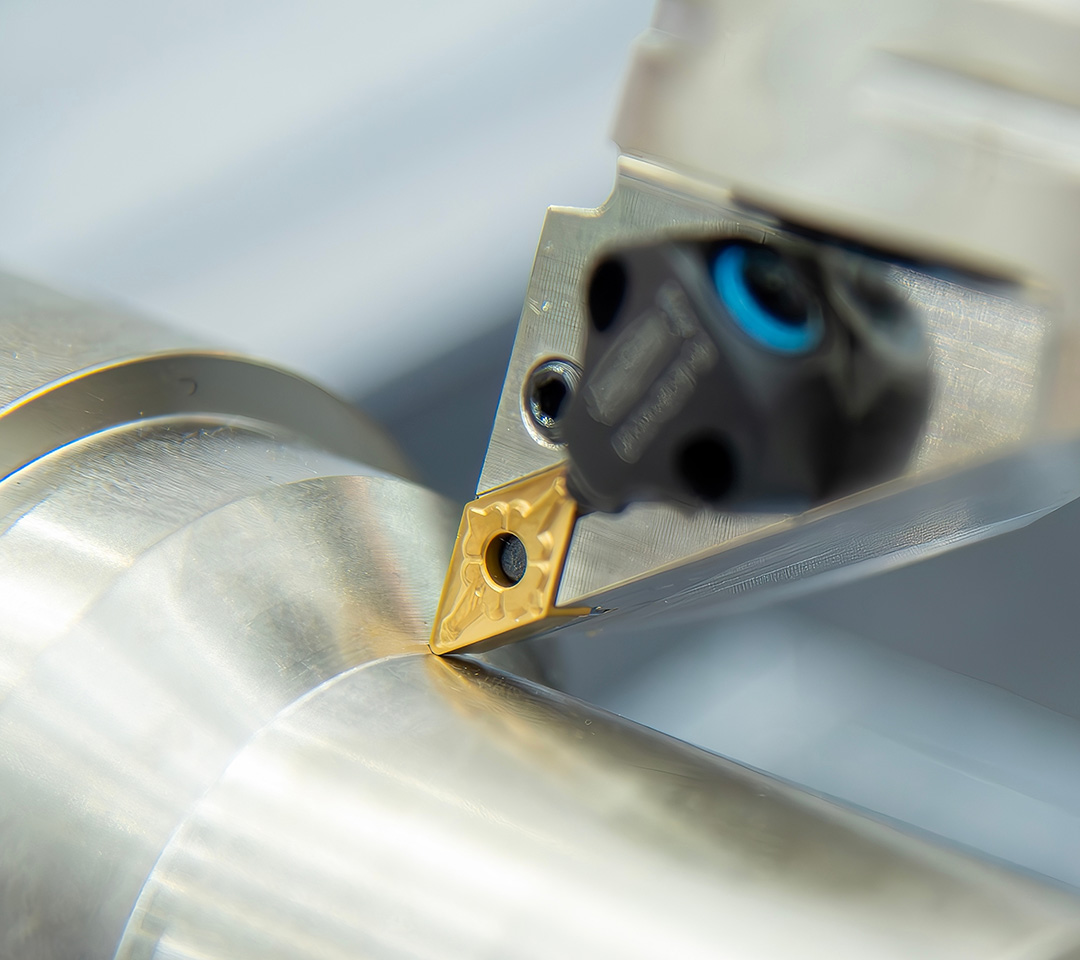

New Product for High-Hardness Material Milling: AP153H Grade
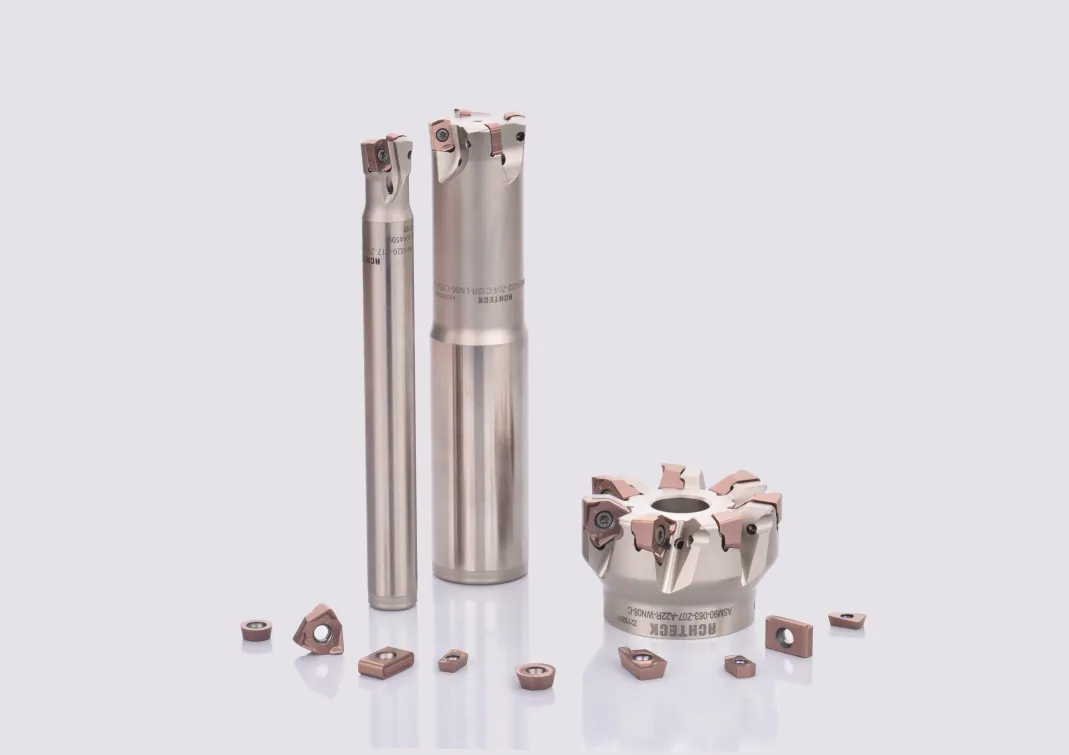
Currently, the demand for machining high-hardness materials such as hardened steel and cast iron continues to rise in mold manufacturing, machining and other sectors, along with increasingly stringent requirements for machining accuracy, production efficiency and cutting stability. In the milling of hardened steel, quenched materials, nodular cast iron and gray cast iron, common industry pain points include frequent insert chipping, severe tool wear and high-temperature-induced coating failure. Traditional tool grades can barely strike a balance among wear resistance, chipping resistance and machining stability, which has become a core bottleneck restricting the efficient machining of high-hardness materials. To address this challenge, ACHTECK Tools officially launches the AP153H, a specialized grade for high-hardness material milling. Backed by innovative substrate preparation and coating structure design, it delivers an efficient, stable and durable professional solution for high-hardness material milling.
What counts as high-hardness, high-wear-resistance materials?
1.Case-hardened steel parts
Example: 16MnCr5 case-hardened, 60 HRC
2.Quenched steel parts
Example: 42CrMo quenched, 55 HRC
3.Quenched bearing steel
Example: 100Cr6, 60 HRC
4.High-speed steel (HSS)
Example: W18Cr4V, 62 HRC
5.Quenched high manganese steel
Example: 65Mn quenched, 60 HRC
6.Wear-resistant white cast iron (high-chromium cast iron)
Example: BTMCr20, 60 HRC
7.High-performance powder metallurgy steel
Example: CPM10V (Cr8Mo2SiV), 60 HRC
1. Insufficient hardness of tool materials fails to complete part machining.
2. CBN tools incur high machining costs, and some machining methods such as milling lack suitable tool options.
3. Excessively fast tool wear leads to unstable machining quality. When cutting high-hardness materials, tools are highly prone to flank wear, which causes gradual degradation of surface quality and dimensional deviation during machining. Frequent downtime for adjustment or tool change disrupts machining consistency and delays delivery schedules.
4. Concentrated cutting heat easily triggers tool failure. Poor thermal conductivity of high-hardness materials causes massive heat accumulation at the cutting edge, which may result in coating peeling, substrate softening and even edge chipping, making sustained and stable machining difficult.
5. Difficulty in balancing machining efficiency and tool life. High-hardness materials usually require conservative cutting parameters, resulting in low machining efficiency. Blindly increasing speed and efficiency will in turn cause rapid tool wear or workpiece burning, making it hard to find a stable window that balances efficiency, tool life and quality.
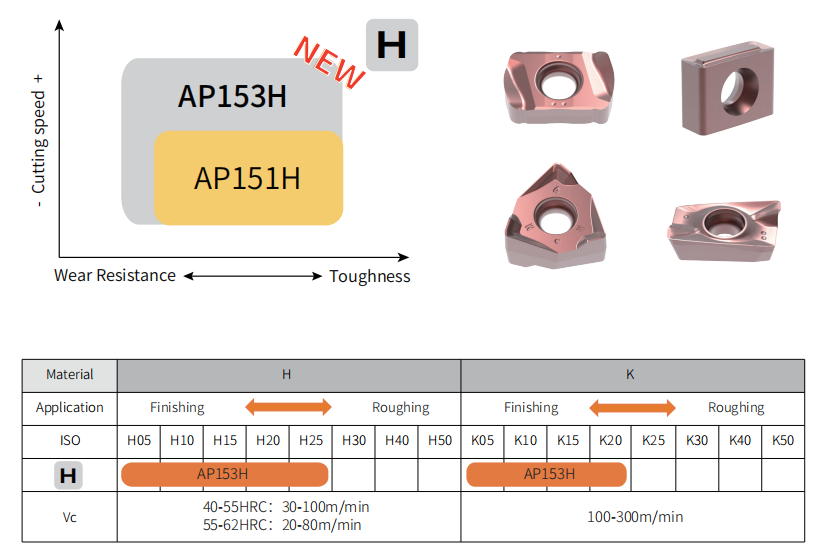
Launch of AP153H, a dedicated milling grade for high-hardness materials, covering a machining hardness range of 45–62 HRC.
Applicable to all common milling scenarios, including shoulder milling, profile milling, high-feed milling and face finishing.
The brand-new grade can effectively extend insert life by around 30%, reduce tool change frequency, improve surface quality and help customers cut costs.
A variety of dedicated chip breaker profiles are available to adapt to different machining stages from roughing, semi-finishing to finishing. While enhancing chip control capability, they reduce cutting force, lower the risk of tool chipping and improve process safety.
Working condition-based selection recommendations and parameter optimization solutions are provided to help customers quickly match the optimal cutting conditions, shorten debugging time, and maximize the balance between tool life and machining efficiency.
Adopts submicron cemented carbide grains to improve the wear resistance and red hardness of the substrate, maintaining edge hardness under high-speed cutting conditions.
Applies nano-composite PVD coating technology to enhance the adhesion between coating and substrate, improve the overall performance of the coating, and prevent chipping and peeling.
The perfect combination of the new substrate and coating ensures the strength of the substrate at high temperatures during long-time milling, while meeting the toughness requirements of the cutting edge under varying cutting loads during milling.
Full-process consistency guarantee: through precision pressing and sintering process control, it ensures high dimensional consistency and minimal performance fluctuation of inserts in mass production, greatly reducing tool setting and debugging time after tool changes.
Dedicated chip breaker geometry for high-hardness materials: targeting the brittle, hard and easy-to-splash chip morphology of high-hardness materials, a dedicated chip breaker structure is developed to achieve controlled chip breaking and smooth evacuation, avoid damage to machined surfaces caused by chip entanglement, and improve machining safety and surface integrity.
The AP153H has a wide range of applications, covering:
Mold & die industry: machining of various hardened die steel parts.
Automotive industry: machining of post-hardening gears, bearing parts, high-wear parts such as vermicular graphite iron and nodular cast iron, and high-performance powder metallurgy parts.
Pump and valve industry: machining of high manganese steel parts.
Other industrial sectors.
It is compliant with ISO cemented carbide classifications H05–H25 and K05–K20, and can be quickly adapted to production lines without customization, delivering greater value for enterprise production.
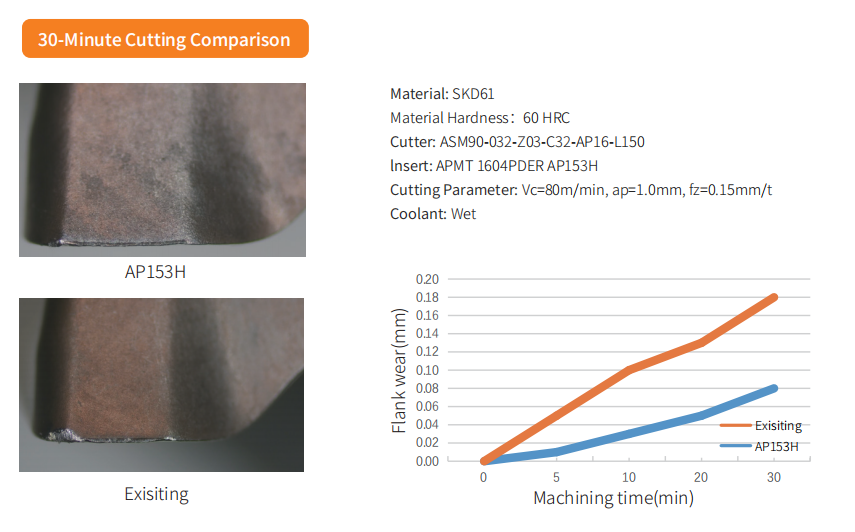
In practical applications, the AP153H delivers outstanding performance. In die roughing of high-hardness materials such as SKD61 and Cr12MoV (workpiece hardness 55–62 HRC), its tool life far exceeds existing products. It effectively improves machining stability and workpiece accuracy, reduces tool change frequency, lowers production costs and creates higher machining value for customers.
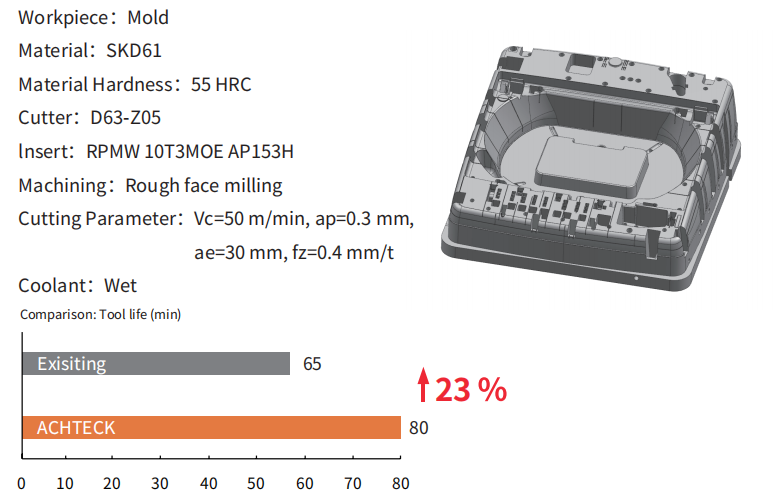
Conclusion: The AP153H grade delivers 23% better performance than the customer’s current inserts, effectively reducing tool change frequency. The customer reports approximately 15% savings in tooling costs. Meanwhile, machining resistance is reduced by around 15% compared with existing products, and cutting noise is also significantly improved.
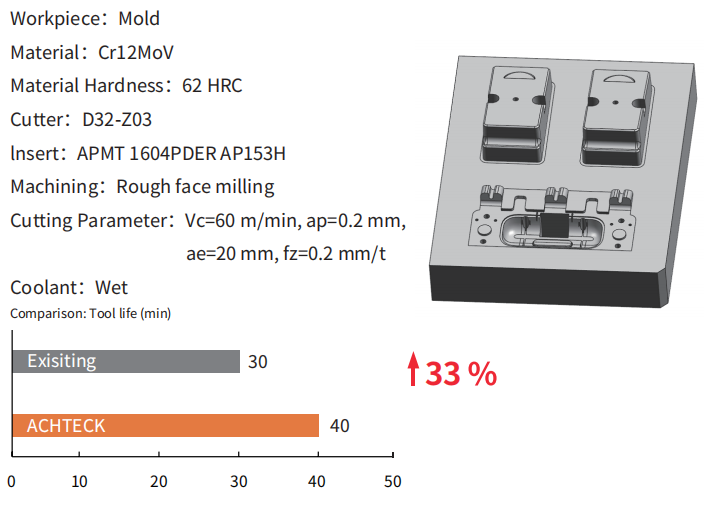
Conclusion: The AP153H grade delivers a 33% performance improvement over the customer's existing inserts, with customer feedback indicating around 20% savings in tooling costs. It also enhances workpiece surface finish, providing a high-value improvement solution that helps customers reduce costs and boost efficiency.
Developed exclusively for milling high-hardness materials, Achteck Tools' AP153H has become a pragmatic choice for numerous customers thanks to its stable and reliable performance. Looking ahead, Achteck Tools will continue to ramp up R&D investment and drive solid technological innovation to deliver more professional cutting tool solutions for high-end manufacturing, empowering customers to achieve dual advancements in efficiency and quality.