Industry Solution | Deep-Cavity Finishing for Aircraft Landing Gears: A Challenge That Leaves the Production Line Afraid to Change Tools — How Does Domestic Substitution Solve It?
The machining case shared in this issue is the left main landing gear outer cylinder of a certain aircraft model. This part is a key load-bearing component of the aircraft landing gear, made of A100 secondary-hardening ultra-high-strength steel, with a heat-treated hardness of HRC52 and a tensile strength of approximately 2000 MPa. The machining task is internal bore finishing, with a single boring depth of up to 850 mm and an overhang length-to-diameter ratio of L/D = 8.5 — a typical ultra-long-overhang, deep-cavity finishing scenario in aerospace manufacturing. The customer previously used imported boring bars and cutting tools exclusively, which met the basic quality requirements for deep-bore finishing of this part; however, under ultra-long travel and high cutting-speed finishing conditions, the insert tip's resistance to high-temperature plastic deformation proved to be a bottleneck. After prolonged cutting, boundary (notch) wear became pronounced, the machined surface quality deteriorated, and machining costs remained high — all of which worked against stable production scheduling for aviation critical parts.
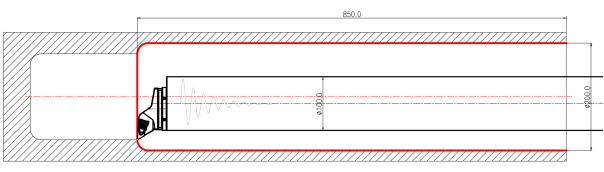
The area indicated by the red line in the part drawing is rough-machined to 2 mm stock per side before heat treatment and then finish-turned after heat treatment.
Machine:Horizontal CNC lathe with internal coolant supply;
Boring bar:Imported damped anti-vibration boring bar, suppressing long-overhang vibration through its damping structure;
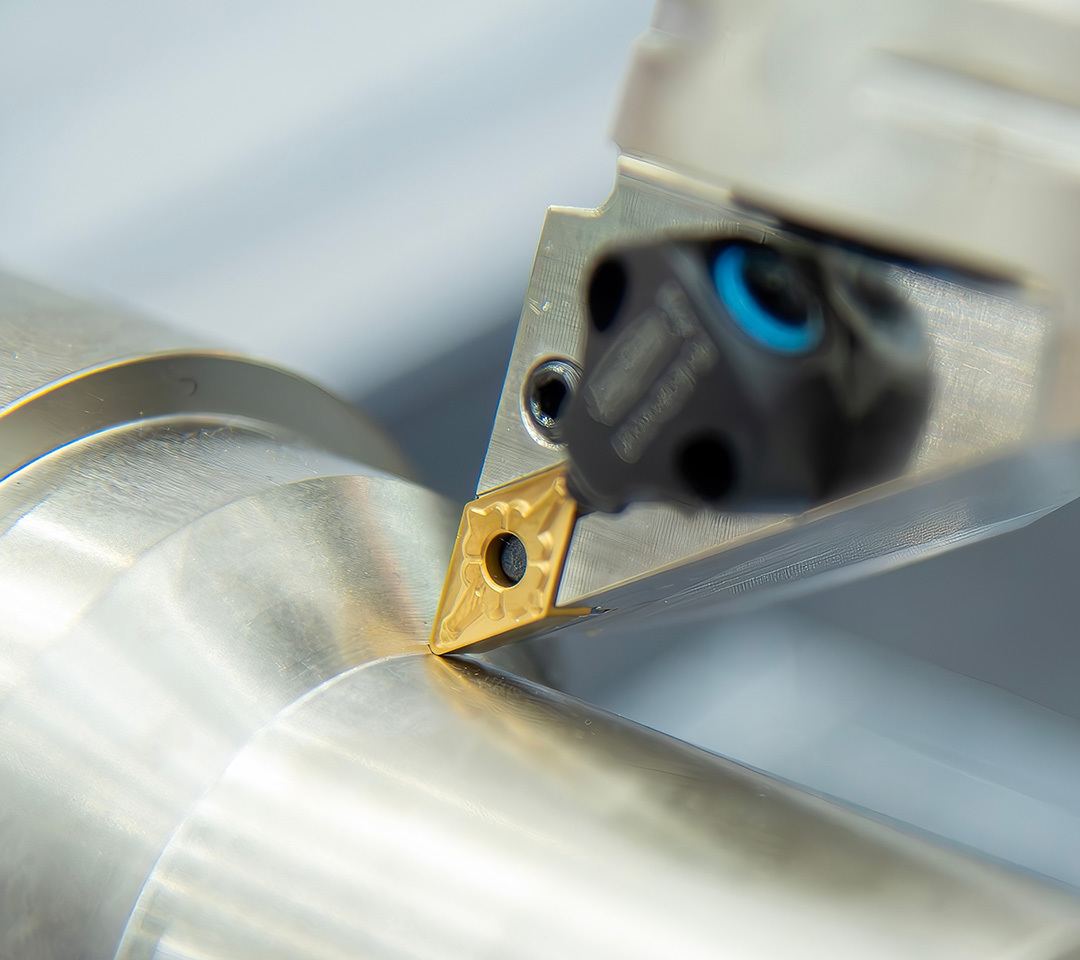
Insert:A German-imported DNMG 150604 finishing insert.
Difficult-to-machine material. After heat treatment, the hardness and strength of A100 ultra-high-strength steel increase significantly, and the cutting process is accompanied by pronounced work hardening. Hard precipitated phases in the material readily cause micro-chipping of the cutting edge and rapid flank wear, placing high demands on both cutting-edge stability and material wear resistance.
Poor process rigidity. Constrained by the machining requirements of other features on the part, the damping bar could be no larger than 100 mm in diameter. With a large overhang ratio, the cutting system rigidity is relatively weak, and even minor fluctuations in cutting force can induce vibration. Once the tool wears or micro-chips, chatter marks appear distinctly, causing the bore surface quality and cylindricity to fall out of tolerance — and in severe cases, scrapping the part.
Supply security concerns. Although imported tools could meet the customer's machining requirements, the landing gear is an aviation critical component, and there was a latent risk of supply interruption.
The solution adopts Achteck's DTB series damped anti-vibration boring bar and DTH series interchangeable cutting head, paired with the DNMG 150604E-SC1 AP010S turning insert for domestic substitution validation. The complete tool set is independently developed and manufactured by Achteck, with full independent intellectual property rights and a self-controlled supply chain — effectively mitigating the risks of long lead times, supply interruption and technology blockade associated with imported tools.
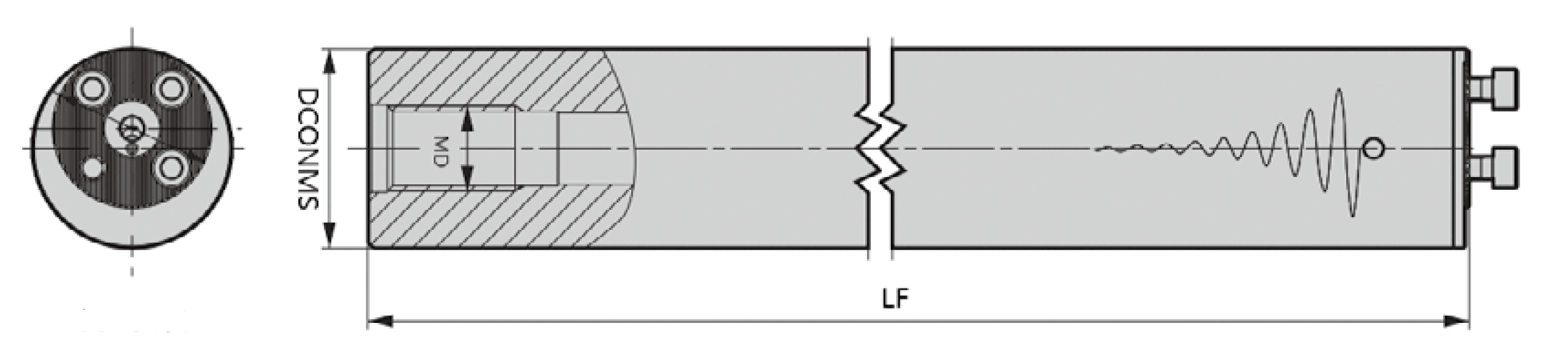
DTB Series Damped Anti-Vibration Boring Bar
Achteck's DTB series damped anti-vibration boring bar incorporates a pre-installed heavy-metal damping mass and an elastic damping medium. When cutting-induced vibration occurs, the damping mass counteracts the vibration mode in the opposite direction and dissipates the vibration energy. All damped boring bars are factory pre-tuned, requiring no on-site re-adjustment of damping, and can be installed and used directly; key performance reaches the level of first-tier imported equivalents. Paired with Achteck's DTH series modular cutting heads, it enables rapid turning, boring and profiling operations, greatly reducing the customer's tool costs and tool inventory.
AP010S is a dedicated PVD-coated grade developed by Achteck specifically for difficult-to-machine materials such as superalloys and titanium alloys. It is one of the preferred grades for high-speed machining of difficult-to-machine materials, while also covering high-speed stainless steel machining and light, brisk machining of hardened materials — precisely matched to the machining demands of such materials.
It uses an ultrafine-grain cemented carbide substrate with substrate-strengthening technology, enhancing the bonding strength between cobalt and tungsten carbide as well as the high-temperature resistance of the binder phase. This improves substrate strength and increases wear resistance, effectively resisting the high-temperature plastic deformation of the insert tip and the abrasive wear encountered in A100 finishing.
It features Achteck's new nanocrystalline, high-aluminum-content coating. With strong coating adhesion, it is not prone to coating spallation failure during long continuous cuts, and offers extremely high hardness together with excellent structural and chemical stability, making it suitable for high-speed finishing scenarios.
The specially treated ultra-smooth coating surface effectively lowers the friction coefficient between chip and cutting edge, suppresses built-up edge formation, and ensures consistently stable surface quality throughout long-travel machining.
SC1 Chipbreaker Technical Features
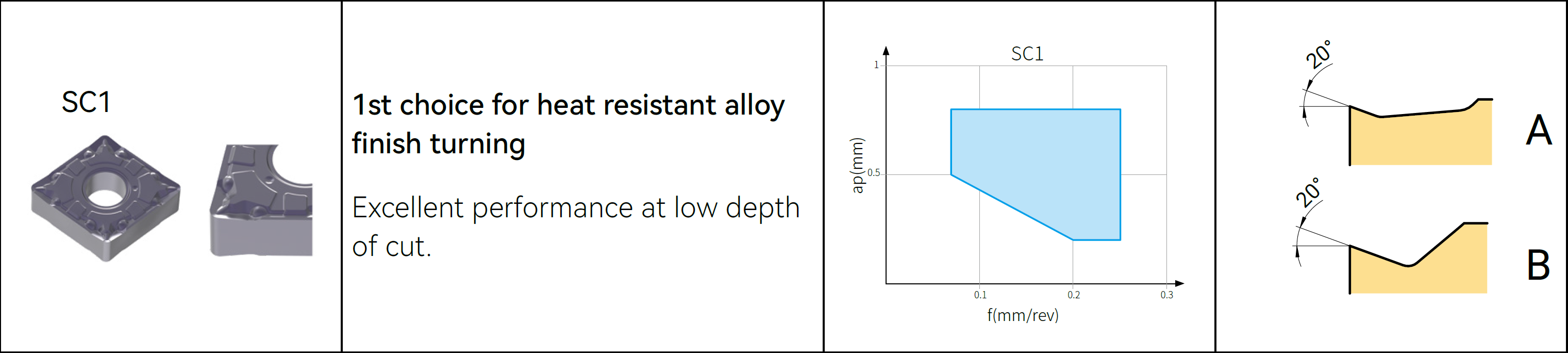
The SC1 chipbreaker is a dedicated finishing chipbreaker for Achteck's negative inserts.
It employs a curved cutting-edge design combined with a progressive rake angle and a segmented shallow chip-breaking land structure, making it suitable for small-depth-of-cut finishing operations. This effectively reduces cutting force and built-up edge formation, ensuring good machined surface quality and long tool life.
It provides controlled chip-flow guidance; when combined with internal coolant in deep-bore machining, it achieves smooth chip evacuation and prevents chips from scratching the already-machined bore surface.
The cutting edge undergoes controlled honing, balancing edge sharpness with micro-chipping resistance, reducing cutting force, and making it well suited to long-overhang damped boring bars and effective avoidance of vibration risk.
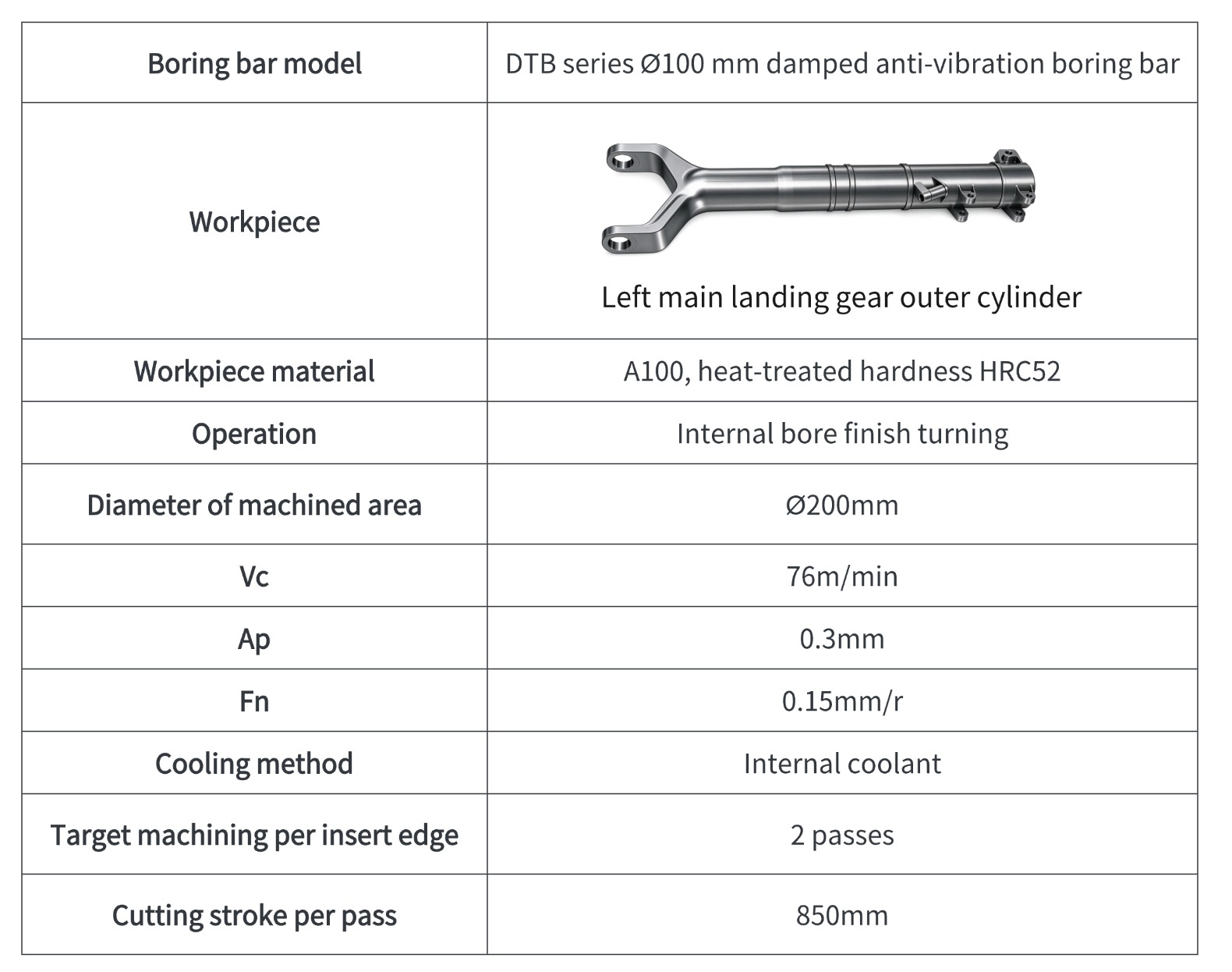
The Achteck tooling solution was run using cutting parameters identical to those of the imported tools. The cutting process was smooth with no chatter marks; cutting was light and brisk, and chips were short. Compared with the original imported insert, chips were easier to evacuate, and no manual machine stops were needed for chip handling. Surface quality in the latter half of the machining was notably better than that of the original imported tooling solution. While completing the same two passes, tool wear was lighter than that of the original insert. Throughout the trial cutting there were no abnormal phenomena such as edge chipping, chatter marks or abnormal noise — overall performance was superior.
A complete domestic solution as a direct replacement for imported tools, with low implementation risk.
Achteck delivers a complete localized solution, and the entire package has undergone process feasibility validation. Implementation requires no modification to existing process equipment, and it can proceed directly to small-batch use without disrupting the existing production takt on site.
Machining performance benchmarked against — and in some metrics exceeding — imported tools.
The self-developed damped boring bar and the dedicated insert work in coordinated fashion and fully meet the quality control standards for aviation landing gear critical parts. Under identical cutting parameters, the cutting process is stable, and both bore surface quality and tool wear control are benchmarked against the imported insert, with some performance metrics exceeding it. On the premise of assured quality, there is further potential to raise cutting efficiency.
Cost reduction, efficiency gains and supply chain security.
By the customer's calculation, the overall procurement cost of the Achteck complete solution is reduced by approximately 50%, while lead times are substantially shortened. This breaks the dependence on imported tools for difficult-to-machine materials such as ultra-high-strength steel in aircraft landing gears, builds a complete domestic tooling process solution, achieves localization of critical machining tools, and secures the supply chain for cutting tools in aerospace manufacturing.