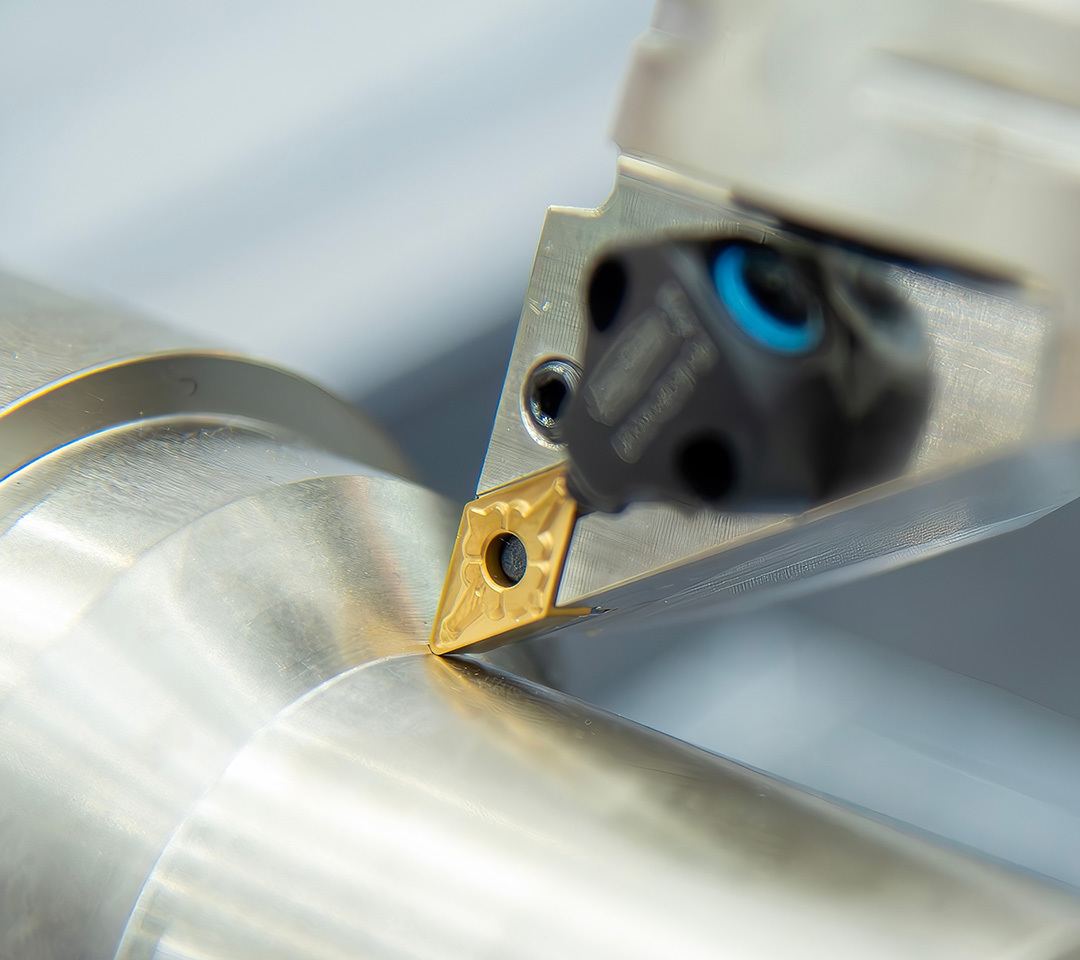
Still Torn Between Wear Resistance and Toughness in Titanium Milling? AP351S Delivers a Balanced Solution
In aerospace equipment manufacturing, titanium alloys have become the material of choice for core components such as landing gear, engine casings and primary load-bearing structural parts, thanks to their high specific strength, excellent corrosion resistance and outstanding overall mechanical properties. However, the inherent material characteristics of titanium alloys — low thermal conductivity and high chemical activity — create a series of stability-control difficulties in milling, which have long been a core focus of on-site process development in the industry. In actual production, failures such as built-up edge formation, edge adhesion, thermal-shock chipping and uneven wear occur frequently, and process commissioning often requires repeated trial cuts to weigh insert wear resistance against toughness before the optimum balance for a given cutting condition can be found.

In real machining conditions, insert selection always involves an inherent wear-resistance versus toughness trade-off: over-emphasizing wear resistance easily leads to edge chipping under interrupted cutting and fluctuating stock allowances, while prioritizing impact toughness results in excessively fast edge wear, which directly increases tool-change frequency, disrupts the established production takt and ultimately raises cost per part.Addressing this common industry pain point, Achteck has introduced the PVD milling grade AP351S, which completes an integrated full-chain matching design from the cemented carbide substrate formulation to the composite coating structure. It simultaneously delivers excellent wear resistance and impact toughness, is designed primarily for titanium alloy milling, and also performs reliably in difficult-to-machine materials such as precipitation-hardened stainless steel and superalloys — offering a highly reliable domestically produced alternative for the milling of difficult-to-machine materials in high-end applications.
Titanium alloys have poor thermal conductivity, so the heat generated in cutting can hardly be dissipated quickly with the chip and a large amount of heat concentrates in the tool-tip region. At high temperature titanium is chemically active and readily cold-welds onto the cutting edge, forming a built-up edge. This scratches the machined surface of the workpiece and causes surface-quality variation, while the continuous chemical interaction also causes coating delamination and accelerates insert failure.
Titanium alloys have a low elastic modulus, and the workpiece springs back noticeably after cutting, so the insert is continuously subjected to compression and friction. In the case of black-skin blanks, uneven allowances and interrupted cavity milling, the cutting edge must additionally withstand cyclic impact. The insert therefore cannot pursue only high hardness and wear resistance; sufficient toughness is equally required to reduce the risk of chipping.
A grade built around a single dominant property can hardly cover a wide range of cutting conditions: rough machining with frequent interrupted impacts favours toughness, while finishing, which demands stable tool life and dimensional control, favours wear resistance. Covering most titanium milling scenarios with one grade requires coordinated substrate and coating matching rather than maximizing any single index.
Technology Decoded: The Substrate and Coating independently Design for AP351S
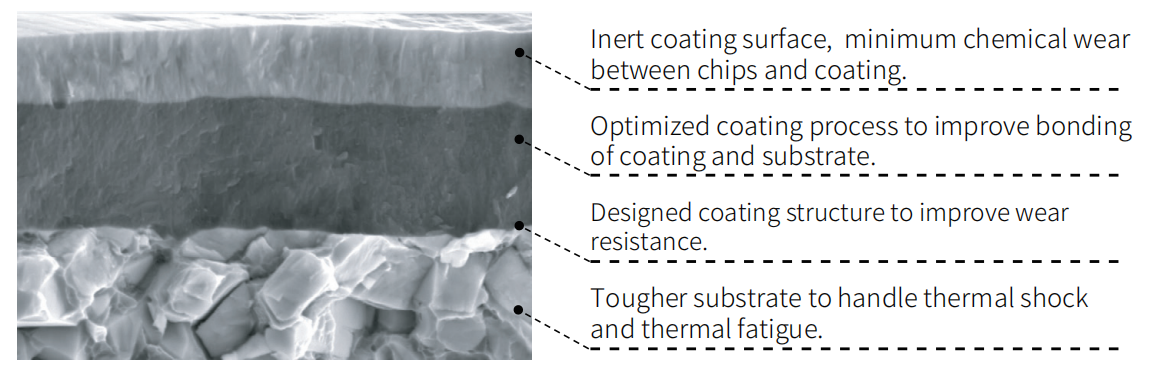
The cemented carbide substrate, produced with an optimized formulation and sintering process, strikes a balanced compromise between wear resistance and toughness; compared with previous Achteck products, wear resistance is improved by 30% and toughness by 15%.
Refined grain-size distribution improves the substrate’s resistance to thermal shock and relieves the plastic deformation caused by alternating heating and cooling during titanium cutting.
Higher internal bonding strength of the substrate improves resistance to interrupted impact, copes with black-skin blanks and fluctuating allowances, and reduces the probability of sudden chipping.
Tool failure is guided toward uniform, controllable wear rather than unpredictable chipping, improving the safety and predictability of machining high-value aerospace parts.
An AlTiN-based composite PVD coating system is used and optimized for the high-temperature adhesion characteristics of titanium alloys:
The coating surface offers high hardness and good high-temperature oxidation resistance, reducing the chemical affinity between the titanium alloy and the cutting edge, suppressing adhesive wear and slowing tool-tip degradation.
It reduces the tendency for built-up edge to adhere to the cutting edge and minimizes coating tear-off caused by the periodic detachment of the built-up edge, stabilizing workpiece surface quality.
Coating-to-substrate adhesion is optimized to delay coating spalling under thermal cycling and interrupted impact, allowing the substrate’s inherent toughness to be fully exploited.
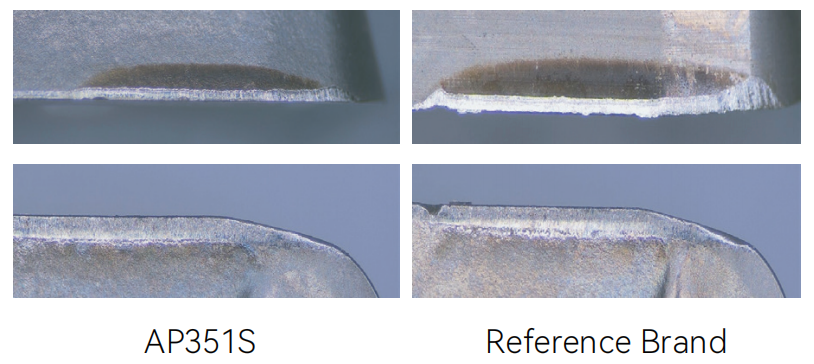
Under identical cutting conditions and identical machining time on TC21 titanium alloy, the flank wear of the AP351S insert was lower than that of the reference sample, confirming its wear performance.
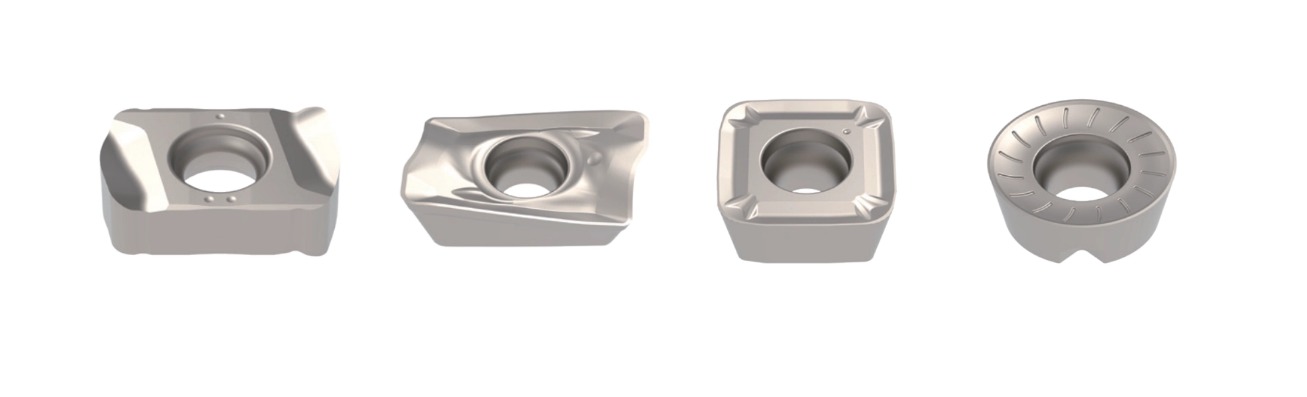
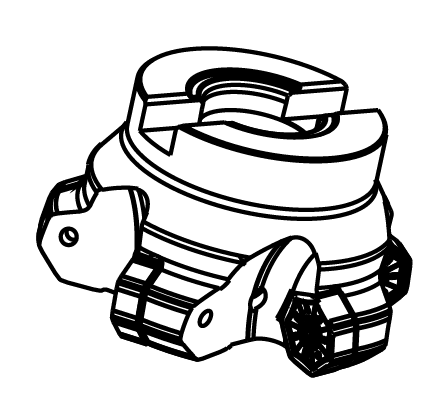
AP351S is not a single insert specification: it can be matched to a number of Achteck indexable milling cutter lines and supports mainstream operations such as high-feed milling, square-shoulder milling and profile milling, covering conditions from roughing to semi-finishing.
High-feed milling cutters:XO, XD and LNMX inserts, for rapid removal of large stock allowances from blanks.
Square-shoulder milling cutters:AD/AO positive-rake light-cutting series inserts with low cutting force, suitable for roughing to semi-finishing of square shoulders and cavities.
Copy (profile) milling cutters:RO series round inserts, for copy milling of blades and complex curved surfaces.
Applicable materials and recommended cutting speeds
Titanium alloys (ISO S) Roughing to finishing:Recommended Vc 30–60 m/min
Stainless steels (ISO M) Roughing to finishing:Recommended Vc 100–190 m/min
So that one grade handles several difficult-to-machine materials and simplifies insert inventory.
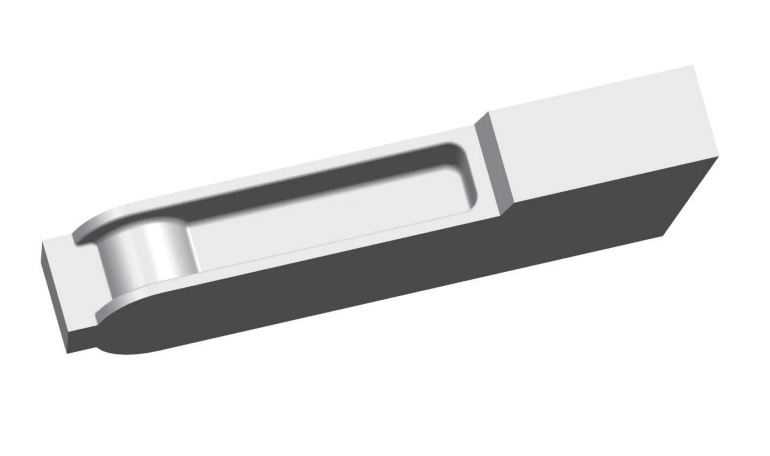
Workpiece:Landing gear strut
Material:TC18 titanium alloy
Tool:AHM10-063-Z06-A22R-XO12-C
Insert:XOGT 120420ER-MS4 AP351S
Cutting parameters:Vc=29.7 m/min,fz=0.7 mm/t,ap=1.5 mm,wet cutting
Result:Previous product: 32 min single-edge life; AP351S: 40 min, a 25% increase in tool life.
Customer benefit:In heavy-stock rough milling of titanium alloy, the insert showed no sudden chipping and wore uniformly, reducing machine-down time for tool changes and improving line takt.
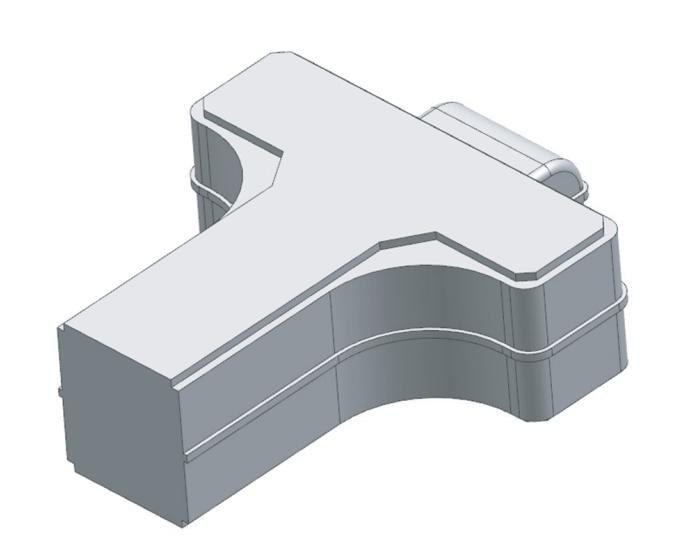
Workpiece:Forged part
Material:TC21 titanium alloy
Tool:AHM10-040-Z05-A16R-XO09-C
Insert:XOMT 09T312ER-MS4 AP351S
Cutting parameters:Vc=62.8 m/min,fz=0.56 mm/t,ap=0.4 mm,wet cutting
Result:40 min tool life; AP351S: 48 min, a 20% increase in tool life.
Customer benefit:Adhesive wear in titanium alloy machining is suppressed, the cutting edge remains stable, rejects are reduced and tool cost per part is lowered.
AP351S is designed primarily for titanium alloy milling and is also suitable for roughing to semi-finishing of precipitation-hardened stainless steels and selected superalloys.
For titanium machining, always ensure sufficient coolant supply to remove heat from the tool tip and further suppress built-up edge and chemical wear.
For black-skin blanks and conditions with large allowance fluctuation, prefer the MS4 and MM4 chipbreaker geometries, which balance impact resistance and chip evacuation.
Achteck Tools supports the development of non-standard insert specifications and provides full technical support covering process selection, on-site trial cutting and parameter optimization.
Titanium alloy milling can hardly be solved across all cutting conditions by a single grade or fixed set of parameters; stable machining is the result of the combined action of grade, chipbreaker geometry, cooling strategy and cutting parameters. When using AP351S for titanium alloy milling, the following practical strategies can be considered:
In roughing with interrupted cutting, control the cutting speed first and reduce Vc appropriately to lower the risk of thermal shock and impact chipping.
In semi-finishing of continuous cavities, keep the feed steady and, provided machine rigidity allows, maintain continuous cutting to reduce the repeated formation of built-up edge.
Inspect insert failure patterns regularly: uniform flank wear is the ideal state. If chipping occurs frequently, check edge strength, cooling conditions and blank allowances first; if built-up edge is severe, change the coolant type or optimize the edge geometry.
For the same grade, the parameter window differs with machine rigidity and fixturing conditions; before releasing a new workpiece to volume production, run a short trial cut to validate the parameters.
Through the two-way optimization of substrate and composite coating, AP351S strikes a balance between wear resistance and impact toughness. Aimed at the machining of aerospace titanium alloy and stainless steel components, this domestically produced milling grade helps on-site processes achieve a more stable machining state.