Four Major Tapping Challenges for Steel — How the T100 Series Cutting Taps Solve Them
Thread tapping on steel workpieces is a common and highly efficient method for producing internal threads and is widely used in real-world production. A wide variety of taps are available on the market, but incorrect selection or improper application can bring a series of machining challenges and problems that compromise both thread quality and machining efficiency. These include: taps breaking off inside the hole, resulting in scrapped threads or parts; poor thread surface quality with heavy burrs, making the threaded joint unreliable and failing acceptance inspection; and go/no-go gauge failure, where the thread does not meet the required tolerance and cannot satisfy the design requirements. To address these common problems, Achteck has launched the T102 spiral point tap for through-hole tapping on steel and the T103 spiral flute tap for blind-hole tapping. Both taps belong to the T100 series of cutting taps. The causes, solutions, and customer benefits are analyzed in detail below.
Through-Hole Tapping — Chip Entanglement Scratches the Thread Surface
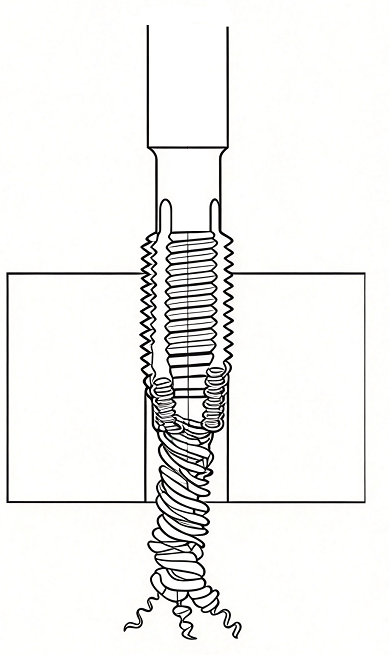
Chips fail to exit through the hole, wrap around the tap or the workpiece surface, and scrape the already-machined threads, causing deteriorated surface roughness and incomplete thread profiles. Operators are forced to stop the machine frequently to clean up, slowing down the machining cycle.
The root cause usually falls into one of three categories:
1、wrong tap type selected (using a spiral flute tap for through-hole tapping);
2、insufficient coolant supply;
3、feed rate too high, producing chips that are too thick to evacuate easily.
Solution approach:
1、prioritize a spiral point tap, which takes advantage of its forward chip-evacuation characteristic;
2、check that the coolant nozzle is aimed at the hole entry, and appropriately increase flow rate and pressure to help flush chips out through the exit end;
3、appropriately reduce the feed rate to avoid chips being too thick, making it easier for the coolant to carry them away.
1、The T102 spiral point tap uses a 5–6 tooth cutting chamfer, distributing the load evenly so each tooth takes on less force;
2、the gun-nose flutes at the front direct chips straight out through the hole exit without backflow.
Smooth chip evacuation and a clean thread surface, improving the first-pass acceptance rate for go/no-go gauges;
fewer stoppages for cleaning and a stable machining cycle;
consistent tool life, suitable for high-volume continuous production with fewer tool changes.
Blind-Hole Tapping — Chip Accumulation Causing Tap Breakage
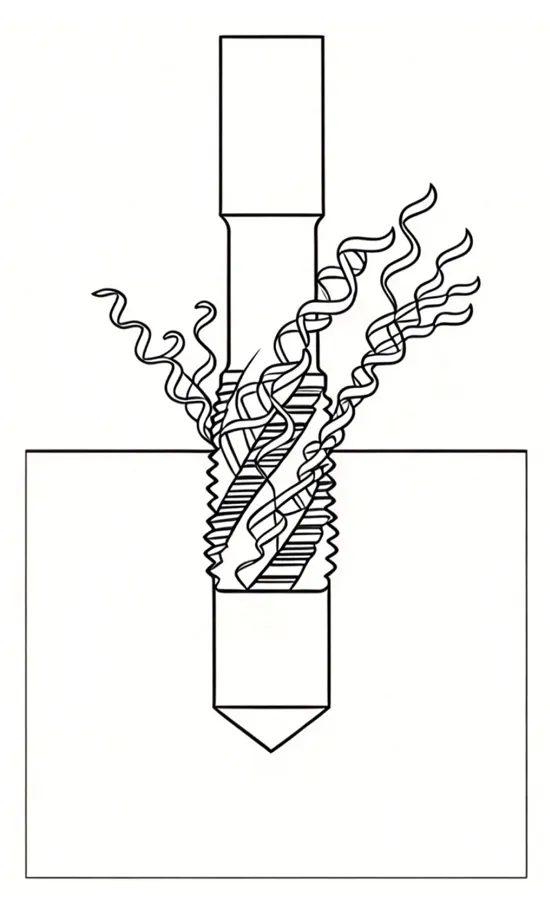
Blind holes have no chip-exit opening, so chips build up increasingly, torque rises sharply, the tap twists and breaks, and the workpiece is scrapped. This is especially pronounced in deep blind holes where the thread depth exceeds 2.5× the diameter. Operators are forced to reduce spindle speed.
The primary cause is an improper tap type (using a spiral point tap for a blind hole). Solution approach:
1、choose a spiral flute tap, which uses its helical flutes to evacuate chips backward; 2、 make the pilot hole 2–3 pitches deeper than the thread depth to provide buffering space for chips;
3、for deep blind holes, a tap with axial through-coolant can be used, where coolant delivered through the tool’s center channel reaches the bottom of the hole and flushes chips out. If the machine tool lacks through-spindle coolant capability, low-volume oil mist lubrication can be adopted instead, reducing cutting-fluid consumption while improving chip evacuation;
4、during tapping, reverse one quarter to half a turn after every half to one full turn of forward rotation, so the chips break before tapping resumes — a very practical chip-breaking technique for blind-hole machining.
1、The T103 spiral flute tap features a sharp cutting point geometry that provides a stable chip shape;
2、a 2.5-tooth transition chamfer balances cutting-tooth count with chip-evacuation space;
3、the spiral flutes guide chips smoothly toward the shank for evacuation, solving the “chip congestion” that causes tap breakage.
Significantly reduced risk of tool breakage and lower workpiece scrap rates;
cutting speeds can be increased by 30%–50% compared with conventional straight-flute taps;
ideal for blind-hole-intensive workpieces such as hydraulic valve bodies and engine blocks.
Rapid Tap Wear and High Tool-Change Frequency
Ordinary HSS taps soften at the cutting edge under high temperatures and wear quickly — a single tap may need replacement after fewer than 200 holes. Operators estimate tool life by experience, and sometimes a severely worn tap continues to be used, causing thread tolerance deviations.
Wear depends on the material’s heat resistance, the coating’s wear resistance, and whether the cutting parameters are reasonable. Solution approach:
1、use cobalt high-speed steel (such as M35), which retains cutting performance at 600 °C;
2、prefer coated taps; an AlCrN coating can extend tool life roughly 6× compared with uncoated taps;
3、recommended cutting speeds: carbon steel 9–15 m/min, alloy steel 5–10 m/min, stainless steel 3–6 m/min — it is better to take the mid-to-low values rather than blindly seeking high speeds;
4、maintain emulsion concentration at 8%–12%; a concentration that is too low accelerates tool wear.
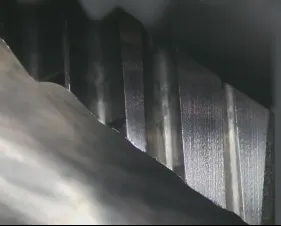

Before wear After wear
The T100 series uses M35 cobalt high-speed steel with an AlCrN coating, so the cutting-edge hardness is well maintained at high temperatures, with wear significantly slower than ordinary HSS.
Longer tool life, fewer tool changes, and lower overall cost;
improved continuous production capability of the line, reducing unplanned downtime.
Unstable Thread Accuracy and Low Go/No-Go Gauge Pass Rate
Thread dimensions fluctuate widely — the go gauge fails to pass or the no-go gauge passes — with a low pass rate. Repeated parameter adjustment finds no pattern, and rework and scrapping occur from time to time.
Three contributing factors:
1、tap manufacturing accuracy;
2、pilot-hole diameter deviation;
3、and back-and-forth axial movement of the tap during tapping.
Solution approach:
1、confirm that the tap’s tolerance class meets the workpiece requirement; generally, 6H accuracy is suitable for most 6H threaded holes;
2、calculate the pilot hole strictly as “nominal diameter minus pitch,” and control the deviation within ±0.02 mm; 3、if the go/no-go result remains unstable, fine-tune the tap’s diameter compensation value, adjusting by 0.02–0.03 mm each time and gradually approaching the acceptable range;
4、 use rigid (synchronous) tapping mode in CNC machining so that spindle speed and feed are strictly matched, avoiding thread pitch errors caused by asynchrony.
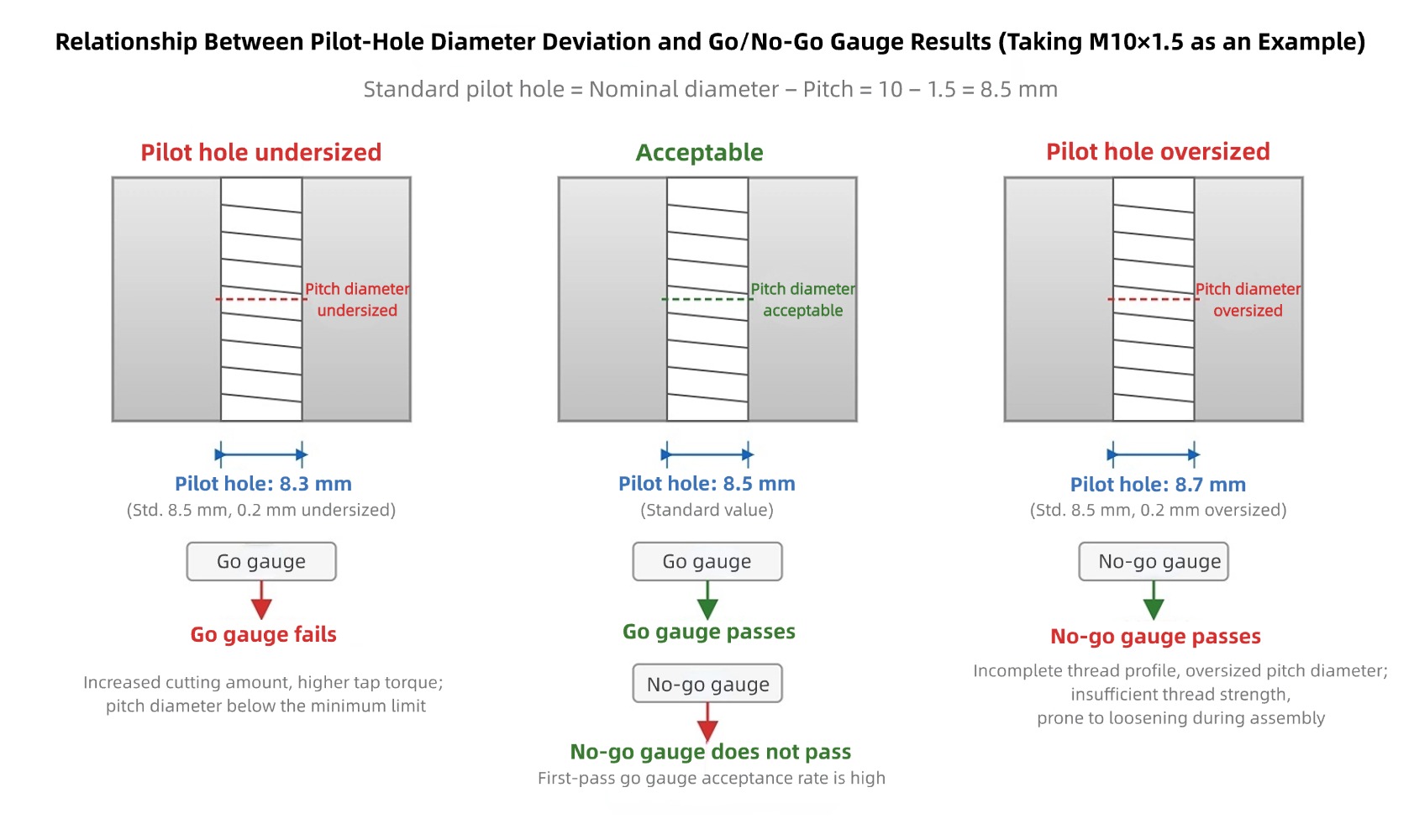
1、The T100 series is manufactured to both DIN (German) and JIS (Japanese) standards, ensuring stable manufacturing accuracy;
2、the highly wear-resistant AlCrN coating provides high-quality thread surfaces with consistent thread accuracy.
High go/no-go gauge pass rate, reducing rework and scrap;
directly interchangeable with imported brand taps, lowering switching costs and procurement risk.
Professional Technical Support & Service
Achteck Technical Support:
If you are facing unstable tap life, difficulty finding the right tool for a specific material, or persistently high tool-breakage rates, the Achteck tool technical team can provide a complete solution — from tool selection to machining parameters — tailored to your equipment conditions, material characteristics, and quality requirements.